Vacationing in Grand Island was very busy! Our campground was next to a park where they shot off fireworks for the first three nights we were there. We had a great view from our campsite.
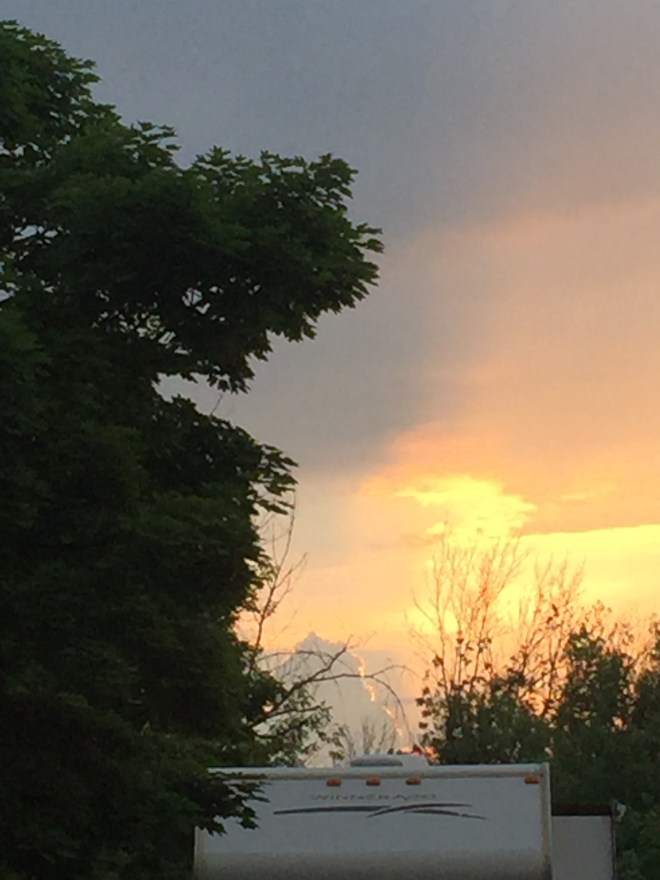
Below is a sunset from our campsite.
One of our stops was the Niagara Aerospace Museum. Both Bell Aircraft Corporation and Curtiss-Wright Corporation had corporate headquarters, research & development (R&D), and manufacturing operations nearby in the middle of the twentieth century, and much of the material on display is from these two aviation companies. Among its many displays are many examples of early to mid-twentieth century piston, turbo-jet, turbo-shaft, and jet engines, as well as several static display aircraft including early Bell helicopters, an example of the World War II Bell P-39 Airacobra, and the Bell X-22 tilt-ducted-fan VSTOL aircraft. I liked the Rosie the Riveter Display!


One evening we took in racing at Ransomville. The original Ransomville Speedway was built behind Ed Ortiz’s service garage during the mid-1950’s, in order to keep the kids from racing on village streets. 2018 marks the 61st season of stock car racing in the hamlet of Ransomville! This was stock car racing on a dirt track.


Fort Niagara was another one of our stops. The history of Old Fort Niagara spans more than 300 years. During the colonial wars in North America, a fort at the mouth of the Niagara River was vital, for it controlled access to the Great Lakes and the westward route to the heartland of the continent. With the completion of the Erie Canal in 1825, however, the strategic value of Fort Niagara diminished. It nonetheless remained an active military post well into the 20th century. The three flags flown daily above the parade ground symbolize the nations which have held Fort Niagara. Each competed for the support of a fouth nation: the powerful Iroquois Confederacy. The French established the first post here, Fort Conti, in 1679. Its successor, Fort Denonville (1687-88) was equally short lived. In 1726 France finally erected a permanent fortification with the construction of the impressive “French Castle.” Britain gained control of Fort Niagara in 1759, during the French & Indian War, after a nineteen-day seige. The British held the post throughout the American Revolution but were forced, by treaty, to yield it to the United States in 1796. Fort Niagara was recaptured by the British in 1813. It was ceded to the United States a second time in 1815 at the end of the War of 1812. This was Fort Niagara’s last armed conflict, and it thereafter served as a peaceful border post. The garrison expanded beyond the walls following the Civil War. Fort Niagara was a barracks and training station for American soldiers throughout both World Wars. The last army units were withdrawn in 1963. Today, the U.S. Coast Guard represents the only military presence on the site. Old Fort Niagara was restored between 1926 and 1934.


The flag above is the flag that hung over the fort during the War of 1812.
During our trip we went to the town of Lockport NY where the Erie Canal is located. While there we took a tour of the original locks and made our way down to an underground manmade hydraulic raceway that powered New York’s 19th century industries. The hydraulic tunnel powered three separate industries with rushing water. Birdhill Holly designed the tunnel. We walked through the first part and then took a boat ride through a part of the tunnel that still contains water. We saw the various escape hatches, there in case the water started coming through while you were in the cave.


We also took a boat ride along the Erie Canal and passed through the locks. It was at least 95 degrees but well worth the trip to experience being raised up and lowered as we passed though the locks in both directions.


Moving on, next up is Niagara Gorge. This is the area after Niagara Falls that leads to where the Niagara River meets with Lake Ontario (by Fort Niagara). We saw this area from above when we took a tour of the highlights in Niagara Falls, from above when we walked the dogs along the rim of the gorge, and on the water when we took a jet boat ride. If you ever get a chance I would suggest the jetboat ride. They take you into the class III to IV rapids and you get to experience the rise and fall (really more like dropping 10 feet or so). We sat inside under cover but you could also sit exposed in the back of the boat where you get very wet as the boat bobs, weaves and drops. After the 4th time through, Jeff was looking a bit pale. The motion was making him a bit queasy just like my mountain driving in Virginia! The video below was taken right next to the strongest rapids which they do not allow the boats to go into.


While on our highlights tour we saw the clock below in the botanical gardens in Niagara on the Lake on the Canadian side.
 Next lets move onto the Falls, both the American and Horseshoe Falls.
Accessible from Goat Island, the Three Sisters Islands are located just beyond the Canada/U.S. border in Niagara Falls, New York. The islands are named after Celinda, Angelina, and Asenath Whitney, daughters of General Parkhurst Whitney of Niagara Falls, New York. General Whitney was one of the more prominent early settlers of Niagara Falls, New York. The General moved to Niagara Falls, N.Y. in 1810 and is best known as the founder and operator of the Cataract House Hotel located near the upper rapids just above the falls. General Whitney’s daughters are believed to be the first settlers to have trekked to the three small islands. Before European settlers arrived in North America, Iroquois shamans made sacrifices of food and gifts on the islands and communed with He-No (Mighty Thunderer), the spirit who dwells in the mist-enshrouded cave at the base of the falls. Modern day psychics believe any one can hear the voices of the spirits if they listen carefully while visiting the Three Sisters Islands. Each island supports a variety of microhabitats and has its own floristic character. The Three Sisters Islands are connected by bridges, allowing pedestrians to walk to all three for grand views of the raging rapids in the Niagara River right before its descent over the grand Horseshoe Falls.
We started our stroll on Goat Island, walked Three Sisters Islands and then moved onto the falls.


Stroll to Terrapin Point and Horseshoe Falls


Beside the American Falls


Behind Horseshoe Falls


Looking up at Horseshoe Falls


Beside Horseshoe Falls


From Skylon


The Falls in the evening

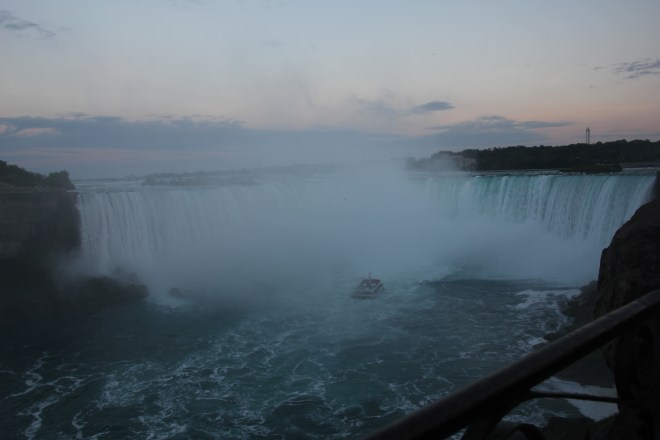
The Falls under the lights!
Moving onto Watkins Glen, we had a visit from my children and did some wine and beer tasting for a few days. We did some hiking with the dogs and had lots of rain. Below are some photos from our hike through Watkins Glen State Park (contains over 800 stairs)!


Next up – Virginia – where we spent August and the first half of September!!
 Fran and Jeff’s Retirement Adventures